
Benchtop Dot Peen Marking Machine
The benchtop dot peen marking machine is the station unit in our pin-marking range. Use it when nameplates, tools and small components come to a bench. A pneumatic or electromagnetic stylus indents serials, logos and 2D codes 0.1–1 mm deep, material dependent.
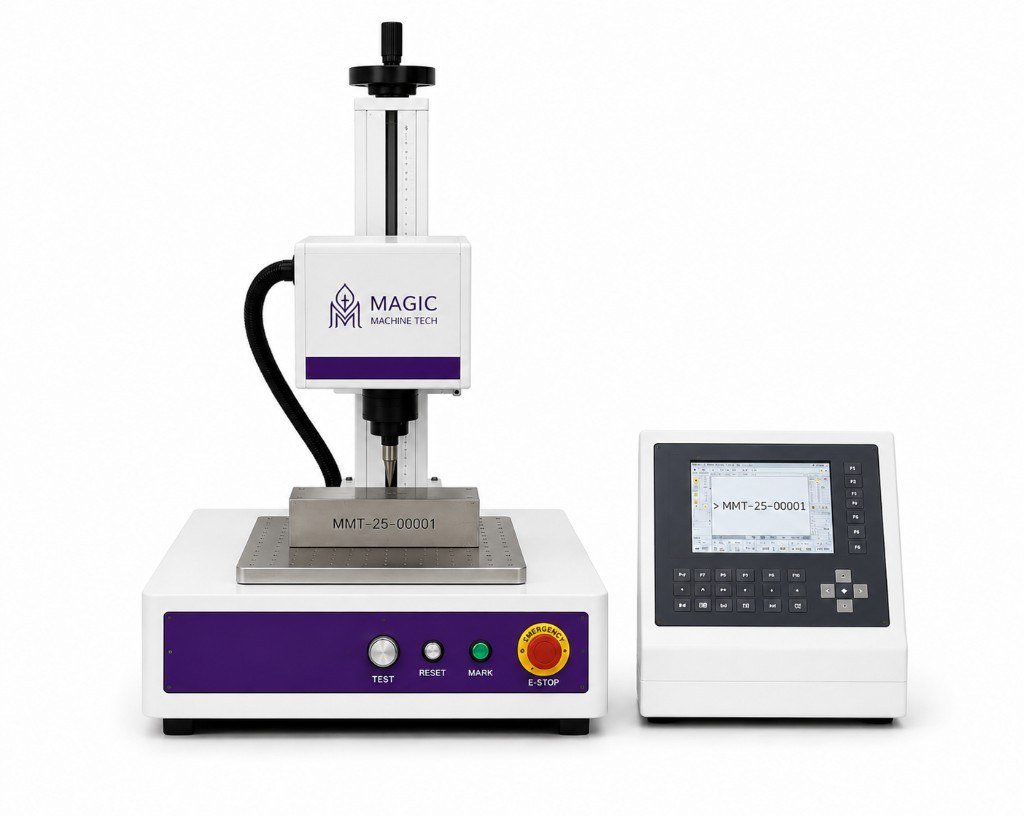
Best for
- Nameplates, engine IDs, batch codes, tool and die marks
- Workshop or line-side small parts
- Repeat jobs with a fixture and USB or standalone controller
Not for
- A truck chassis or tank in the yard (handheld)
- Fine jewellery surfaces (gold fiber)
- Heat-sensitive plastics (UV)
vs siblings
Benchtop: part to machine. Handheld: machine to part. Job: deep metal marking.
Handheld dot peen · Deep metal marking · Dot peen family
Specs
| Parameter | Value |
|---|---|
| Marking area | 120 mm × 40 mm (customisable) |
| Marking depth | 0.1 mm – 1 mm (material dependent) |
| Workpiece height | Up to 200 mm |
| Stylus control | Pneumatic / electromagnetic |
| Power supply | 220V / 50 Hz |
| Interface | USB / serial / standalone |
| Control | Embedded controller / PC-based |
| Supported materials | Steel, aluminium, brass, some plastics |
Features
- Deep dot-matrix mark that survives paint and handling better than a surface laser anneal in many ID jobs
- Flat, curved or irregular parts within travel and fixture limits
- Easy file transfer via USB or direct input
Materials
Steel, aluminium, brass, hard plastics as trialled. Coatings and hardness change depth — sample first.
Applications and industries
Accessories
Custom windows, fixtures, stylus grades — specify on the quote.
Why this model
A compact DPM station when parts can be lifted onto a table.
FAQs
- Why not “Standard” in the H1?
- The machine is a benchtop. The old slug stays for SEO; we do not use three names for two models.
- Laser instead?
- Use fiber when you need contrast without an indent. Use this when the indent is the point.
Tell us the part size, material and how deep the ID must be.