Fiber Laser Marking Machines
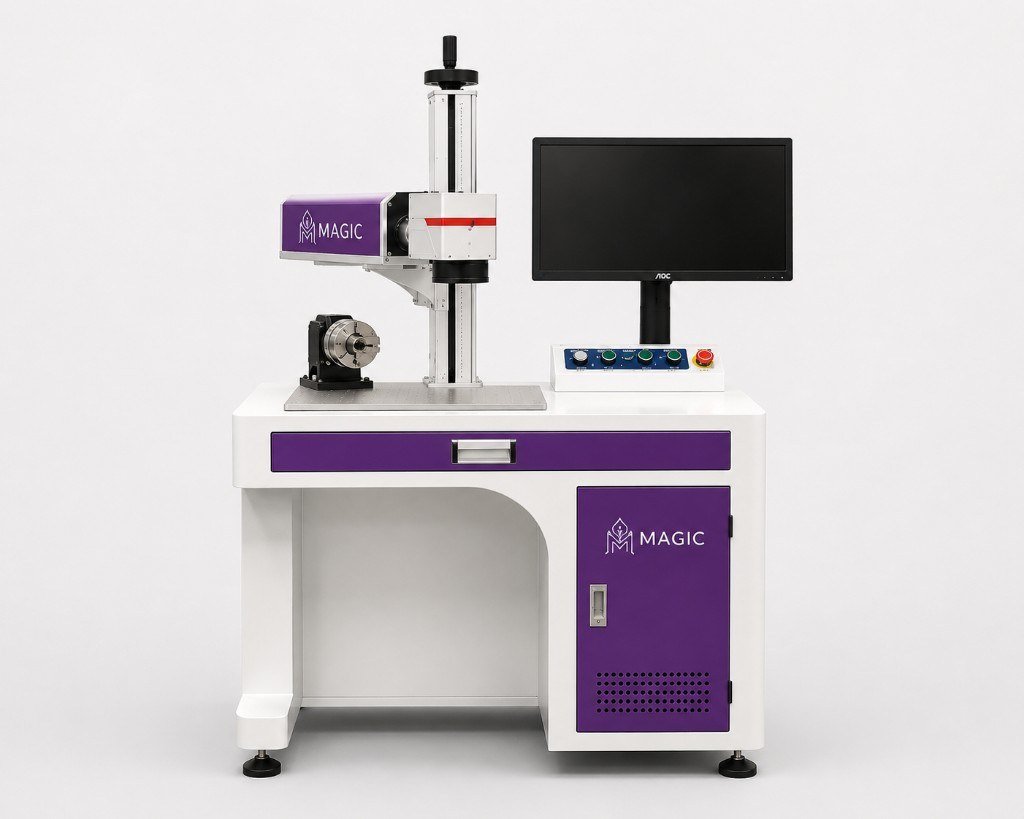
Fiber laser marking machines put a permanent mark on metals and many engineering plastics at 1064 nm. We supply 20W to 100W systems with sources from IPG, JPT, Raycus or MAX, in five formats: desktop, portable, handheld, fly (inline) and gold/hallmarking.
Who this family is for
Use fiber when the part is steel, stainless, aluminium, brass, copper, titanium, carbide or a markable engineering plastic — serials, QR, logos, traceability. It is the default industrial metal marker.
It is the wrong first choice for heat-sensitive plastics and PCBs, for wood/acrylic cutting, and for deep stamped IDs that must survive coating or abuse. See UV , CO2 and dot peen .
How it works
A fiber source feeds a galvo scan head. The 1064 nm beam anneals, engraves or foams the surface without ink. Typical software: EZCAD; LightBurn where the controller allows it. Air-cooled on this range — no chiller for standard marking cells.
Formats
-
Desktop (standard)
Repeat jobs at a workstation
Stationary cell. Plug in, fixture the part, mark. Production, assembly or inspection.
View format -
Portable
Move the box between cells or sites
Box-type body. Same fiber process, built to move without a dedicated cabin.
View format -
Handheld
Large, awkward or fixed parts
Gun-style head and compact controller. Take the beam to the part.
View format -
Fly
Moving conveyor / line, no stop
Encoder or photocell trigger. Mark while the line runs. Serial, date, shift in software.
View format -
Gold
Precious metals, hallmarking, jewellery shops
Same wavelength family, set up for gold, silver, platinum and fine jewellery work — not a heavy industrial DPM station.
View format
Family specs (range)
Model pages list speed, field and extras for that format. Do not treat this table as one SKU.
| Parameter | Value |
|---|---|
| Wavelength | 1064 nm ± 5 |
| Power | 20W / 30W / 50W / 100W |
| Sources | IPG / JPT / Raycus / MAX |
| Typical field | 70×70 mm to 500×500 mm (lens-dependent) |
| Cooling | Air-cooled |
| Software | EZCAD (standard); LightBurn where supported |
| Voltage | AC 220V, 50/60 Hz |
| Source life | Up to 100,000 hours typical, source and duty cycle dependent |
Industries
Applications
- Serial, QR and traceability
- Jewellery marking and hallmarking
- Inline laser marking
- VIN and chassis marking
Supplied from Coimbatore to plants across India. Locations · Coimbatore
FAQs
- Fiber vs UV?
- Fiber for metals and many hard plastics. UV when the part cannot take heat — including many PCBs.
- Fiber vs dot peen?
- Fiber for contrast and fine codes without impact. Dot peen for deep, indented IDs.
- Which wattage?
- Set after we see material, depth and cycle time — often via sample marking.
- Will it mark every metal?
- Most engineering metals yes. Coatings and mirrors need a trial.
Tell us the metal (or plastic), the code or logo, and whether the part comes to a bench, a gun, or a line.