
Desktop Fiber Laser Marking Machine
The desktop fiber laser marking machine is the workstation unit in our fiber range. Use it when parts come to a bench — production, assembly or inspection. It marks metals and engineering plastics at 20–100W, 1064 nm, with an air-cooled source (IPG, JPT, Raycus or MAX).
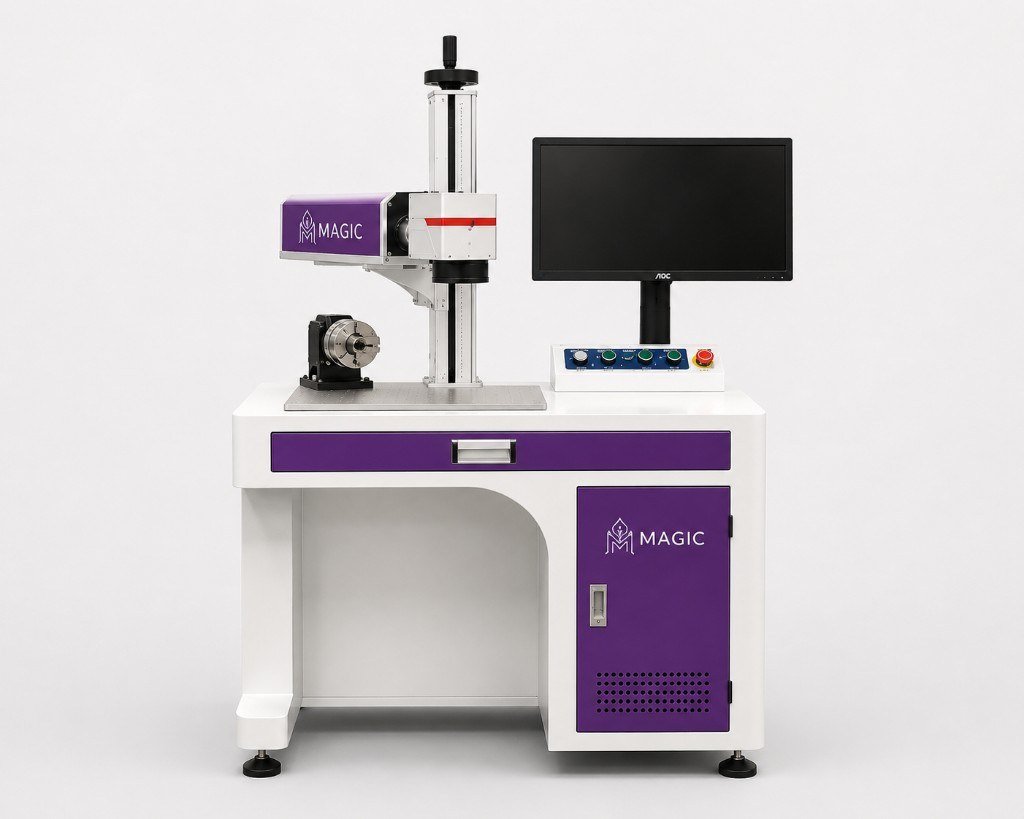
Best for
- Repeat serials, logos and QR on small-to-medium metal parts
- A dedicated marking cell next to assembly or QC
- Shops that want a fixture, optional rotary and an enclosure
Not for
- Chassis, tanks or machines that cannot come to the bench (handheld)
- Unattended conveyor coding (fly)
- Hallmarking jewellery as the main job (gold)
vs siblings
Same fiber process as portable and handheld. Desktop is the stable, enclosed (or open-frame) station. Portable is the box you move. Handheld is the gun.
Portable fiber · Handheld fiber · Fiber family
Specs
| Parameter | Value |
|---|---|
| Laser power | 20W / 30W / 50W / 100W |
| Wavelength | 1064 nm ± 5 |
| Marking speed | Up to 15,000 mm/s (file, material and source dependent) |
| Marking field | 70×70 mm to 500×500 mm |
| Min. line width | 0.01 mm |
| Min. character height | 1 mm |
| Repeat accuracy | ±0.01 mm |
| Laser source | IPG / JPT / Raycus / MAX |
| Cooling | Air-cooled |
| Software | EZCAD (standard) / LightBurn where supported |
| Voltage | AC 220V, 50/60 Hz |
| Source life | Up to 100,000 hours typical, source and duty dependent |
Features
- Air-cooled marking cell — no chiller on this class
- Optional rotary, motorized Z, F-theta lens set, enclosure, fume extraction
- USB / PC workflow for logos, serials and 2D codes
Materials
Steel, stainless, aluminium, brass, copper, titanium, carbide, coated metals, and markable engineering plastics. Confirm coatings with a sample.
Applications and industries
Accessories
Motorized Z, F-theta lenses, rotary for cylinders, protective enclosure, exhaust kit.
Why this model
Stable fixture, short setup, the usual first fiber machine for a plant that has a marking station.
FAQs
- 20W vs 50W vs 100W?
- Depth, speed and hard metals push wattage up. We set it after a sample.
- Enclosure required?
- Recommended for open shops and visitors; not always required for a controlled cell.
- Plastics?
- Some yes with fiber; heat-sensitive parts → UV.
Tell us the metal, the mark, and whether the part sits on a bench.